
Congress Should Implement Climate Disaster Pay for Farmworkers

Despite growing and harvesting food for our nation and the world, many U.S. farmworkers struggle to afford basic needs, including safe housing, groceries, utilities, and health services. Farmworkers are one of the lowest paid occupational groups in the U.S., and many feel they need to keep working through potentially dangerous conditions such as wildfires and extreme heat in order to pay for rent and essentials.
Recent research from my group at UC Berkeley and a community engagement team led by local farmworker advocate Zeke Guzman found that 97% of farmworkers surveyed in Sonoma County, California said they would be “very worried” about lost income if there were a wildfire and they could not work. Nearly all participants (98%) indicated it would be difficult to pay for rent and other essentials if they lost work due to a wildfire.
Climate Reality on the Ground
“We have to work to be able to pay for rent or else we get evicted.”
This quote from a study participant highlights the stories my team hears every day from farmworkers regarding their need to continue working during wildfires and other natural disasters to make ends meet.
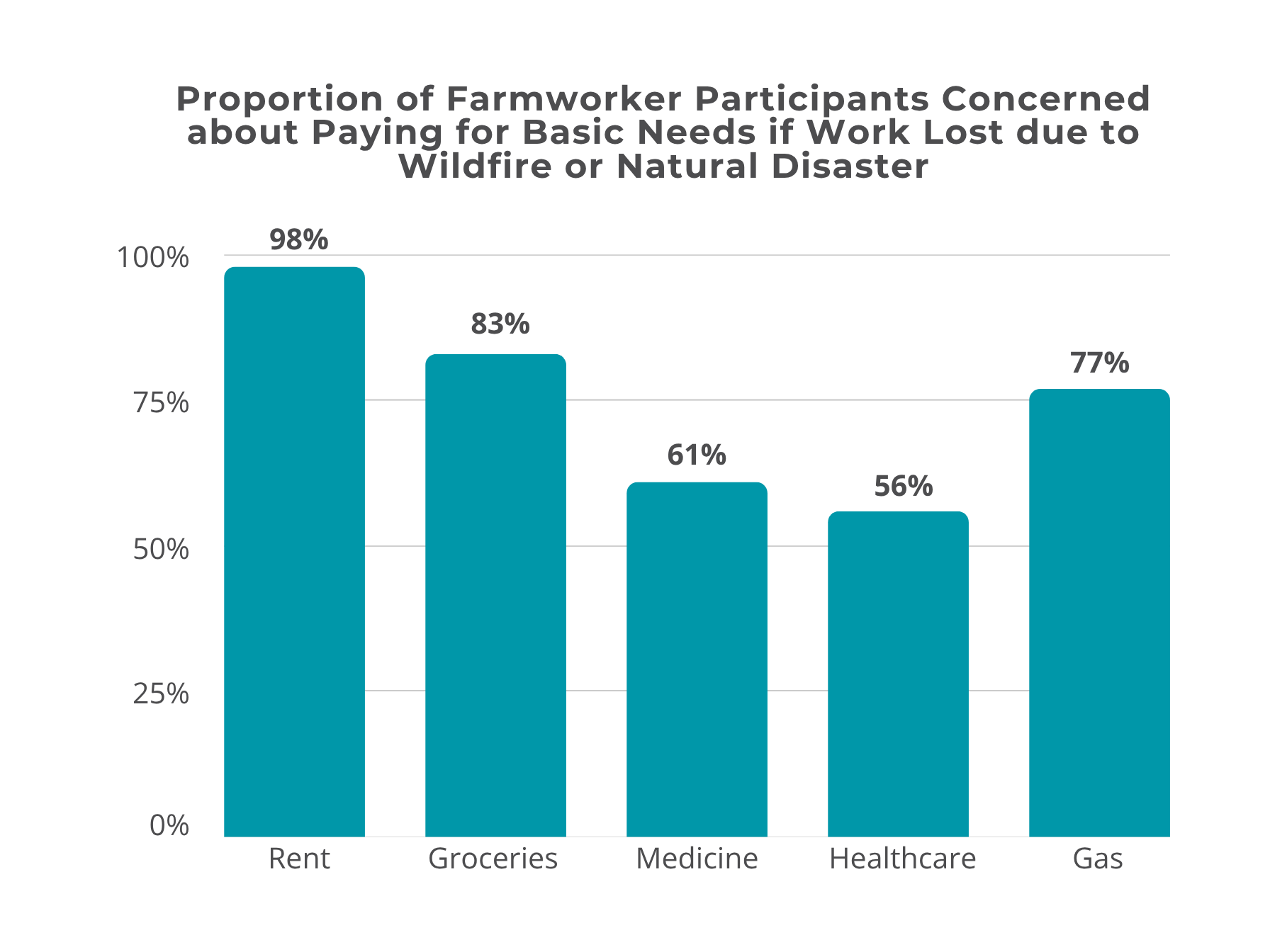 From California to Georgia and Florida, climate change is exacerbating tensions between health and economic security. In addition to direct impacts on their health, disasters such as wildfires, floods, heat waves, and hurricanes are increasingly threatening work opportunities for farmworkers, making it nearly impossible to keep up with monthly bills. Work from our group with a cohort of over 1,000 farmworkers in Sonoma County found that most participants spent between 50-75% of their monthly paycheck on rent. This shows how difficult it is for many farmworkers meet basic needs under ideal conditions, let alone when a natural disaster prevents work. One participant shared: “The last time [the wildfires] occurred, we were left many days without work. We were in a lot of debt, and it was even more difficult to sustain ourselves.” Nearly all participants (98%) said it would be difficult to pay for rent if they lost work due to a wildfire. Climate change will continue to increase the frequency and intensity of these disasters, threatening farmworkers’ wages and ability to meet basic needs.
Disaster Pay to Support Farmworkers
Congress should act quickly to protect vital, marginalized farmworkers by implementing disaster pay, or unemployment insurance, that would provide them with continued wages during natural disasters, similar to payments for those who lost work during the COVID-19 pandemic. While some farmworkers are eligible for unemployment insurance, the eligibility criteria are complex and vary across states. Notably, those without documentation are not eligible for unemployment and are often excluded from other safety net benefits, such as food and housing assistance. This creates a system that leaves farmworkers with few resources to afford basic needs when climate change threatens work opportunities and places the burden on state and local jurisdictions to meet these gaps. In the absence of comprehensive disaster pay, farmworkers are also incentivized to continue working through climate catastrophes that will harm their short- and long-term health, often without access to health insurance. Another study participant said: “To be honest, it is very hard to stop working even if we are in danger because of wildfires, or smoke, or bad air quality. We still have to work. We do not have any other form of income.”
In a time when immigrants are increasingly demonized and the few resources offered to this group are being clawed back, it is important to remember that the U.S. agricultural system is entirely dependent on migrant workers and would collapse without them. Nearly 70% of crop farmworkers were born outside of the U.S., many of whom do not have work authorization. Individuals without documentation status contribute nearly $12 billion in state and local taxes each year. Even though their employers pay into state and federal unemployment funds, including an estimated $13 billion from 2010-2019, workers without documentation status are not able to access these benefits or other safety net resources.
Congress Must Act Now
In the absence of comprehensive federal unemployment insurance, workers have few options when they don’t have enough work to make ends meet. This increases strain on local governments to support workers through disaster after disaster, underscoring the need for federal action. In California, State Senator María Elena Durazo authored SB 227 in 2023 to create an Excluded Workers Program that would expand unemployment insurance for undocumented workers, providing up to 20 weeks of emergency assistance. In May, U.S. Senator Alex Padilla introduced the Disaster Relief for Farm Workers Act that would provide the exact services supported by the research presented here, such as disaster relief grants, collaboration between the USDA and farmworker organizations, and emergency assistance for farmworkers.
To address this pressing issue, Congress should:
- Pass legislation to provide disaster pay to farmworkers when they lose work due to natural disasters, available regardless of documentation status.
- Expand social safety net benefits to farmworkers regardless of documentation status, including housing assistance, healthcare, and food assistance.
- Develop a strategy to engage farmworkers, advocates, and farmworker-facing Community Based Organizations (CBOs) in the development and deployment of programs for farmworkers.