
Every Student Deserves a School Nurse

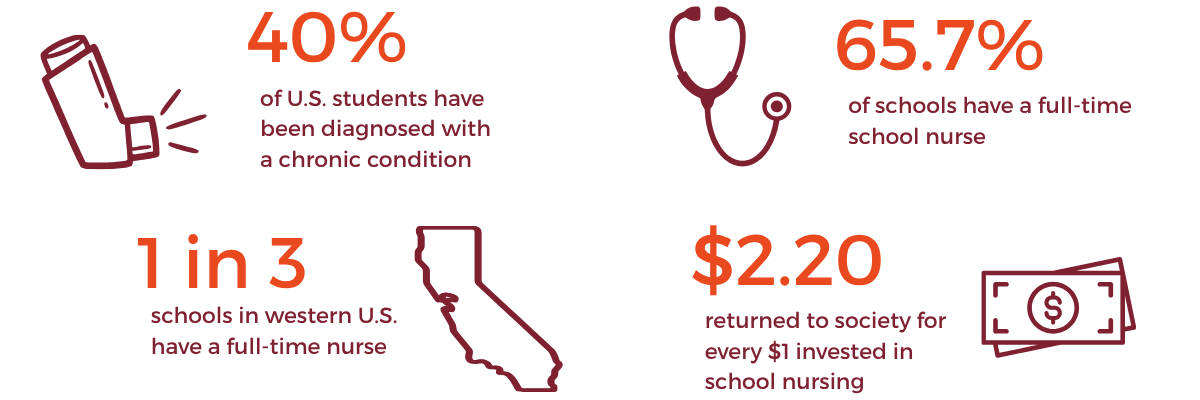
Every child in this country deserves to show up to school safe, healthy, and ready to learn. More than 40% of school-aged children have been diagnosed with at least one chronic health condition such as asthma, diabetes, severe allergies, epilepsy, or a behavioral or learning condition. Despite the prevalence of these conditions that can become emergencies in the classroom, millions attend schools without a full-time registered nurse. This gap has consequences. School nurses sit at the intersection of child wellbeing and academic success. They are often the only licensed healthcare professional in a school and for many children in rural and low-income communities, the only consistent point of contact with the healthcare system. Every student deserves daily access to a full-time registered nurse, and federal policy should make that a reality.
The School Nurse Access Crisis
Only 65.7% of U.S. schools have a full-time registered nurse on-site every day. Six percent have no nurse at all. The gap is starkly regional: in the western United States, only one in three schools has a full-time nurse, compared to nearly nine in ten in the Northeast. Rural schools and Title I schools fall furthest behind. The students paying the price are kids in low-income communities, kids from minoritized populations, kids living with disabilities or chronic conditions. These are the students least likely to have a primary care provider outside of school.
The investment case is equally clear. A peer-reviewed study in JAMA Pediatrics found that for every dollar invested in school nursing, society gains $2.20 back through prevented medical costs, reduced parent work absences, and protected teacher instructional time. School nurses are not a budget cost; they are an investment with a documented return.
The Critical Role of School Nurses
A school nurse is often the only licensed healthcare professional in an entire school building. On any given day, a school nurse is managing insulin for a student with Type 1 diabetes, developing an individualized health plan for a child with epilepsy, conducting vision and hearing screenings that catch problems no one else noticed, and doing a quiet mental health check-in with a student who dropped by their health office. They coordinate with pediatricians, counsel families navigating a complex healthcare system, and collect population-level health data that signals where students are struggling before those struggles show up as failing grades or empty chairs. When that care is absent, students don't just miss health services, they miss school.
The Solution to the School Nurse Gap: The NURSE Act
Every student should have daily access to a full-time registered school nurse. The American Academy of Pediatrics, National Association of School Nurses, and American Federation of Teachers all endorse this. H.R. 3262-NURSE Act authorizes targeted federal demonstration grants to help under-resourced and Title I school districts hire school nurses.
Recommended Actions
The NURSE Act (H.R. 3262), introduced by Rep. Titus with bipartisan cosponsors, is the right first step: federal demonstration grants to help under-resourced districts hire school nurses. Members of U.S. Congress should:
- Cosponsor and support the NURSE Act (H.R. 3262) to authorize grants that help underresourced and Title I districts hire full-time registered school nurses
- Urge the House Committee on Education and Workforce to schedule a hearing on the NURSE Act
- Request a briefing from the National Association of School Nurses. I am also available as an ongoing resource for any child health