

In communities across the United States, a persistent narrative links immigration, including undocumented immigration, with increased crime rates. Despite overwhelming evidence to disprove this narrative, this belief has shaped decades of policy, fueled heated political debates, and influenced public opinion. This disconnect matters deeply in a nation where approximately 47 million immigrants call America home. As immigration enforcement budgets grow and immigrant communities face intensified scrutiny, the human and social costs of misguided policies deepen.
Immigration Enforcement Policies
Local involvement in immigration enforcement has expanded through a series of programs and policies that delegate and train local officials to act on behalf of federal immigration authorities. Key initiatives include:
- 287(g) agreements. Authorizes U.S. Immigration and Customs Enforcement (ICE) to deputize local police to perform immigration enforcement tasks.
- Secure Communities Program. Trains local police to transmit and check fingerprints against federal systems at the time of arrest, regardless of conviction.
- Criminal Alien Program. Provides ICE-wide support in the identification, arrest, and removal of incarcerated “criminal aliens.”
- Laken Riley Act. Requires the Department of Homeland Security (DHS) to detain undocumented immigrants convicted of (or charged with) theft-related crimes, assaulting a police officer, and others.
These policies are often justified by the claim that immigrants pose a significant threat to public safety—a claim not supported by evidence.
Immigration Enforcement Policies Do Not Mean Safer Communities
Comprehensive analysis of over 50 research studies reveals a striking disconnect between common assumptions and empirical reality: immigration and crime simply do not go hand in hand. Key findings from our analysis include:
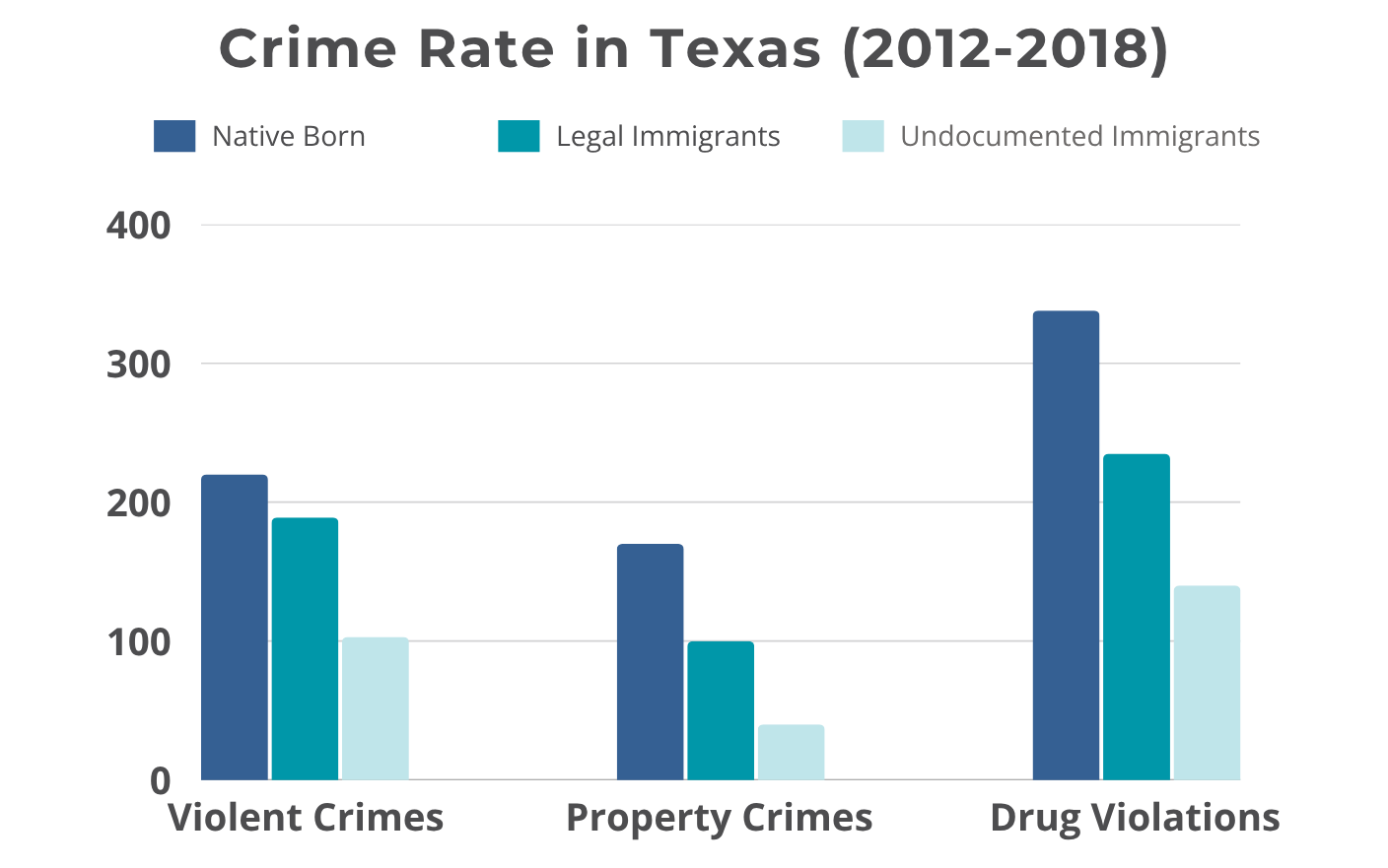
- Immigrants, including those who are undocumented, have lower involvement in crime than native-born individuals across a wide range of offenses, including violent crime, property crime, drunk driving, and school-rule violations. As seen in the graph below, both legal and undocumented immigrants in Texas have a lower crime rate than native born citizens.
- Studies of cities, neighborhoods, and metropolitan areas consistently find no positive relationship between immigration and crime.
- Sanctuary policies, which limit local law enforcement’s involvement in federal immigration enforcement, are not associated with higher crime rates. For example, following the passage of California’s SB54 sanctuary policy, crime rates did not rise .
Enforcement programs such as 287(g) and Secure Communities are ineffective at reducing crime and may, in fact, make communities less safe. The reality on the ground contradicts the stated intentions of these policies. Though designed to identify and remove "dangerous criminals," enforcement actions predominantly sweep up individuals with minor infractions.
By deputizing local police to carry out federal immigration duties, these programs erode trust between immigrant communities and law enforcement. Victims become wary about reporting crimes out of fear that any contact with police might lead to deportation proceedings. Witnesses remain silent. Communities become more vulnerable, not safer. These policies and practices also open the door to abuses such as racial profiling.
The consequences extend through families and communities. When deportations occur, children, often U.S. citizens themselves, suddenly lose a parent. One policy decision creates a cascade of new social challenges that span generations.
Approaching Immigration Policy through Evidence
Little is gained by enacting harsh, restrictive, and exclusionary policies aimed at immigrants or by punishing sanctuary jurisdictions. These approaches do not enhance public safety and often cause substantial harm to families and communities. Instead, policymakers should:
- Stop enacting policies based on an assumption of widespread immigrant criminality. Immigration enforcement efforts should be grounded in evidence, not fear or misinformation.
- End local immigration enforcement programs. End the use of 287(g), Secure Communities, and similar initiatives that erode trust between immigrant communities and law enforcement, and that fail to deliver on public safety promises.
- Establish federal guardrails that protect sanctuary jurisdictions. Prohibit federal retaliation against cities and states that limit their participation in immigration enforcement.
- Redirect enforcement resources to more pressing crime concerns such as gun violence and gender-based violence. Reallocating resources away from punitive immigration crackdowns toward initiatives that prevent and respond to serious violent crime would represent a more effective and equitable use of public dollars.
Immigration policy should reflect reality, not rhetoric. The evidence is clear that immigrants are not driving crime, and punitive enforcement strategies do not make communities safer. By shifting away from fear-driven policies and toward evidence-based approaches, we can promote both public safety and community well-being—ensuring that our immigration system upholds justice, not prejudice.
For a full review of all studies related to immigration and crime in the United States, read Dr. Charis Kubrin’s book, Immigration and Crime: Taking Stock.