
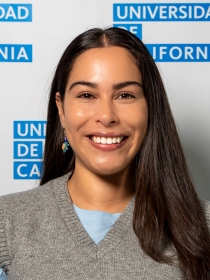
Mayra Puente
Connect with Mayra
About Mayra
Puente's research focuses on higher education access, equity, and success for rural Latinx students, particularly those from migrant farm worker backgrounds in rural areas of California, such as the San Joaquin Valley and Central Coast agricultural regions. Overarching themes in Puente's writings include college opportunity; college proximity; geographic isolation; the intersection between race and space; and higher education access and attainment as a tool for social mobility, community empowerment, and societal transformation.
Contributions
Bridging the College Gap for America’s Growing Rural Latino/a/x Population
In the News
Publications
Examines the higher education pursuits of 16 rural Latina/o/x students from migrant farm working backgrounds living in California’s San Joaquin Valley agricultural region, exploring how these students' lived experiences in a conservative, anti-immigrant region inspired resistance, dreaming, and transformation.
Reviews findings from several pláticas conducted over 4 years which reveal that (a) institutional misalignment, (b) new passions, (c) financial responsibilities, and (d) familial relationships contributed to rural Latinx students’ nonlinear college choice pathways.
Uses findings from the qualitative plática (conversation) data with rural Latinx community college students to show that students faced (a) a lack of academic rigor, (b) limited degree and certificate types, and (c) minimal career guidance and exposure.
Synthesizes and analyzes 24 peer-reviewed empirical journal articles to reveal that higher education researchers typically failed to employ a theoretical framework to conceptualize these intersections or relied on race-neutral economic perspectives to study geographic disparities in college choice. The analysis of the methods used by higher education researchers found that scholars over-relied on quantitative research approaches, such as regression analyses.
Explores the challenges and motivations of rural Latinx college students pursuing STEMM (Science, Technology, Engineering, Mathematics, and Medicine) fields. Finds that these students' intersectional identities and geographical backgrounds are central to their STEMM pursuits.
Extends the methodological proposal of “ground-truthing” in Critical Race Spatial Analysis (CRSA) to consider GIS as Critical Race Feminista Methodology (CRFM).
Examines the educational experiences of multilingual rural Latinx students from California’s San Joaquin Valley agricultural region, finding that these students are hyperaware of their linguistic marginalization within their K–12 schooling experiences and their migrant farm worker parents’ exclusion by English-only U.S. institutions.
Argues that place is foundational to processes and consequences of racialization, yet “the where” is often missing in race-centered research, especially in the discipline of education. Delves into the author's formal and transdisciplinary training in Critical Race, feminist, and spatial theories in educational research and juxtaposes this training with her rural Latinx im/migrant farm working community's daily experiences with racialization in California's San Joaquin Valley.
Examines the impact of geography on college access, particularly for rural and Hispanic communities. Discusses Hillman’s research, which shows that areas with larger Hispanic populations, lower educational attainment, and rural characteristics often have limited access to nearby colleges—termed “education deserts.”
Examines the college choices of nine rural Latinx high school seniors from California’s San Joaquin Valley who chose to attend a public higher education institution in this agricultural region. Findings demonstrate that rural Latinx students purposely chose these institutions because they imagined that such institutions would (a) be racially and spatially familiar, (b) allow them to give back to their rural communities through relevant majors, and (c) offer tight-knit collegiate environments.
Challenges the traditional, objectivist use of geographic information systems (GIS) by introducing Platicando y Mapeando, a Chicana/Latina feminist GIS methodology. Presents five principles of this methodology and provides a case study of the college (in)opportunities available to rural Latinx youth from California’s San Joaquin Valley to illuminate the significance of this methodology for researchers interested in interrogating the intersections of race, gender, space, and educational (in)opportunity.
Examines the college (in)opportunities and conscious choices of rural Latinx students from California’s San Joaquin Valley as they pursued higher education during the pandemic. Finds that rural Latinx students lacked access to quality technological devices, internet infrastructure, high speed internet, and college information and guidance. Still, these students enrolled in colleges that aligned with their and their families’ financial and emotional realities during the ongoing pandemic.
Centers the college choice experiences of rural Chicana/Latina students, drawing on the five tenets of a Critical Race Theory (CRT) in Education framework as well as the author’s own cultural intuition, personal and professional experiences, and existing literature.