
Investing in Healthcare to Keep Students in Class
Connect with the author


Absenteeism is shaped by factors often beyond schools’ control, including student health, poverty, and environmental exposures. For example, asthma is a leading cause of missed school, and living in higher-poverty or polluted areas results in more absences. Chronic absenteeism is defined as missing 10% or more school days, and is linked to lower school readiness, test scores, graduation rates, peer performance, and teacher satisfaction. Students may miss additional school days if they lack reliable healthcare access. This can also include a lack of healthcare coverage, transportation resources to get to and from the doctor easily, or scheduling issues that require students to miss school for a doctor’s appointment.
Rising Absenteeism and the Threat of Medicaid and Other Federal Cuts
Absenteeism spiked during the COVID-19 pandemic and remains high. Recently, states have made absenteeism part of school accountability systems, and districts are taking more systematic approaches to improving attendance. However, efforts to reduce absenteeism could be undermined as the Trump administration is considering cutting Medicaid with the new tax plan. One of many unforeseen consequences could be exacerbating chronic absenteeism, and thus, negatively impacting student learning. The latest federal cuts have been $1 billion in funding for school mental health that was provided through the 2022 Bipartisan Safer Communities Act, passed in the aftermath of the school shooting in Uvalde, Texas.
Medicaid, in combination with Children's Health Insurance Program (CHIP), provides healthcare for over 40 percent of all U.S. births, for 90 percent of children in foster care, half of all children with special health care needs, one-third of all school-aged children (approximately 37 million), and for more than 40 percent of children in rural and underserved communities. In a survey conducted this year by Healthy Schools Campaign, over 1,400 school administrators nationwide estimated that proposed Medicaid cuts would lead to a 70% reduction in mental health providers, a 47% reduction in physical health services, and a 29% reduction in Medicaid outreach and enrollment services.
Research on Healthcare Access and Absenteeism
Our preliminary analysis of the 2017- 2023 National Survey of Children’s Health (NSCH) data covering over 160,000 students across all years shows a clear link between unmet healthcare needs and chronic absenteeism. Students who did not receive necessary healthcare were absent 1.13 additional school days per year, even after considering free/reduced lunch status, chronic illness, school belonging, school safety, gender, race, age, insurance coverage, and Adverse Childhood Experiences (ACE) scores.
Trends in unmet healthcare needs reveal concerning patterns. The percentage of students with unmet healthcare needs ranged from 2.7% in 2017 to a high of 4.4% during the COVID-19 pandemic in 2021. When looking at specific unmet needs over time, medical, vision, and ear care appear relatively stable. However, unmet mental health needs spiked during the COVID-19 pandemic and have leveled off but remain high compared to other healthcare needs. While dental needs decreased during the pandemic, they are still relatively high. Mental, dental, and medical health were the most frequently selected healthcare needs. Among the 3.8% of children from 2017 to 2023 who did not receive needed care, 30-40% of their parents cited mental, dental, or medical care as the care their child needed but did not receive.
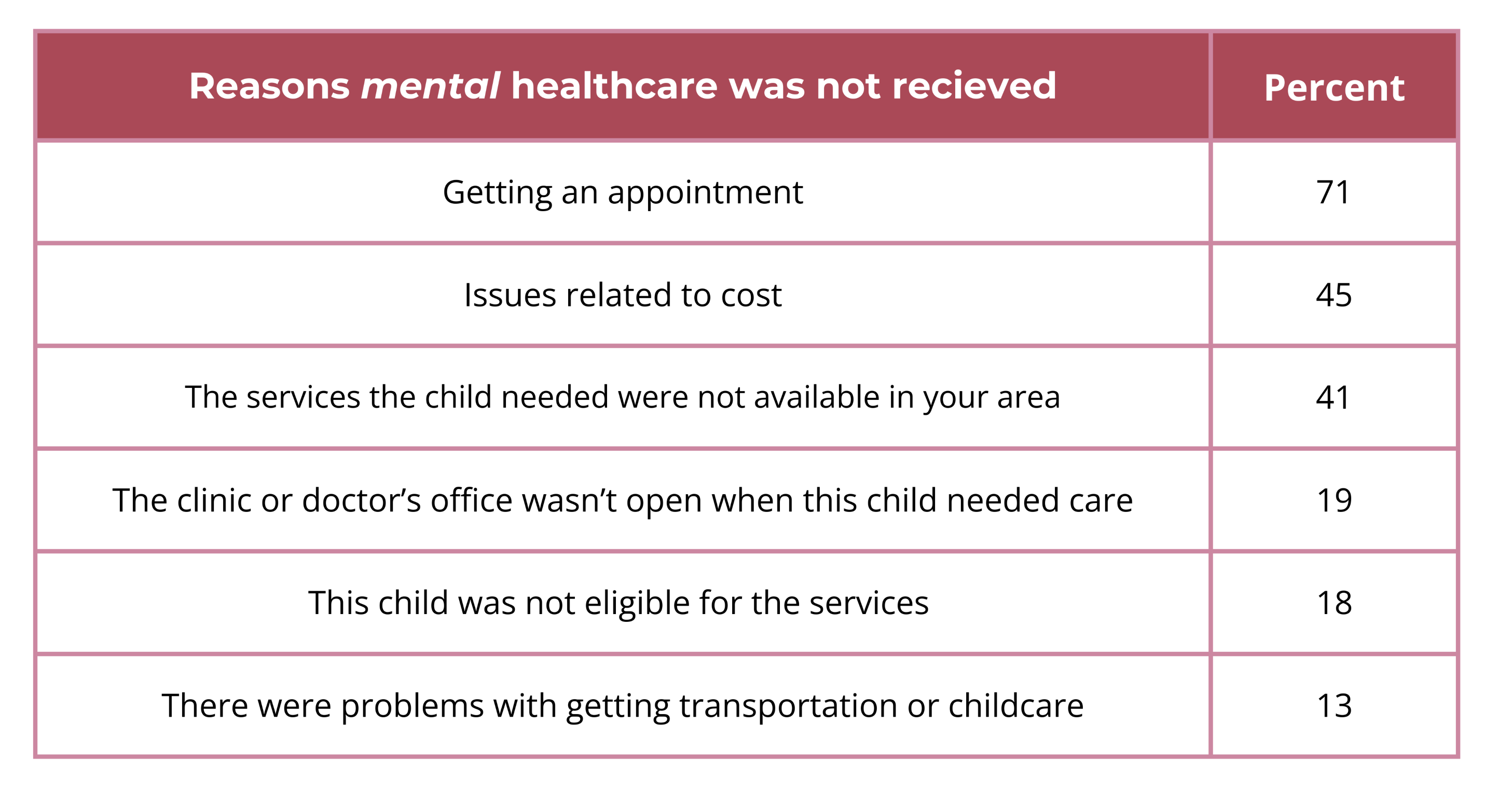
Given the sharp rise in unmet mental health needs, we conducted a deeper analysis. When parents were asked why their children were not receiving mental health care, the most cited reasons were difficulty in getting an appointment and the cost. Geographic and political disparities are also significant: eight of the top 10 states with the highest proportion of students who did not get mental health services when needed were also red states during the 2024 election.
These findings bring attention to the fact that, in addition to the many reasons why students are absent (e.g., academic difficulties, family circumstances, and/or negative school experiences), students may miss additional school days if they do not have reliable access to healthcare.
Current Approaches
In recent years, the federal government, states, and localities have implemented promising legislation and programs to support students’ health needs. For example, under the School-Based Mental Health Services (SBMHS) grant, the Department of Education allocated 19 million to fund states and local school districts for mental health services personnel. At the state level, Wisconsin is investing $300 million in mental health services for schools, including programs and training for students, caregivers, and schools, increasing mental health providers. In 2024, Delaware passed legislation to lower student-to-counselor ratios (from 1:382 to 1:250) and student-to-psychologist ratios (from 1:2,547 to 1:700). On a local level, Seattle expanded youth mental health partnerships with a $7 million additional investment, bringing its total youth mental health budget to over $19 million.
Policy Recommendations
These initiatives show what’s possible when leaders invest in students' health. Rather than reversing progress through proposed Medicaid cuts, policymakers should double down on investments that strengthen access to care and help students thrive. To accomplish this, policymakers should:
- Increase funding for Medicaid. Strengthen Medicaid to ensure children, especially in low-income and rural communities, have access to comprehensive health services, especially preventative mental and dental care.
- Improve access to mental health care. Invest in initiatives like school-based health centers, telehealth services, and community partnerships to reduce wait times, expand provider availability, and lower healthcare costs for families.
- Support school-based health initiatives. Provide sustained funding for schools to hire more mental health professionals and nurses, building on successful models like the School-Based Mental Health Services (SBMHS) grant.
Every student deserves the chance to be healthy, present, and ready to learn. By prioritizing students' health through stronger Medicaid funding and expanded access to critical services, we can create the conditions every child needs to attend school consistently, learn effectively, and reach their full potential.