You had a busy spring—five policy briefs, two published op-eds, and others in the works. What motivated that push?
I really wanted to have an op-ed and a policy brief for every academic article I published. That was a goal I set for myself because I don’t want my research to be siloed or just for the academy. I want it to influence policymakers and inform the general public. SSN really inspired me.
One of my op-eds ran in EdSource, which is widely read by California policymakers and educators. As a result, a colleague who does public scholarship offered to be my mentor for the William T. Grant Scholars Program. Another op-ed in The 74 on corporal punishment connected me with the Mississippi Coalition to End Corporal Punishment. They needed answers and saw me as a resource. They asked that I write two more policy briefs—one on restorative justice and one on social-emotional learning—as tools they could use when meeting with school districts to help them replace corporal punishment.
They also connected me to a superintendent in Mississippi who eliminated corporal punishment in his district. I’m hoping to do a study on how they navigated that transition—interviewing teachers and administrators to see if behaviors changed and how the policy was implemented in practice.
You’re part of SSN’s Education Scholars Training Program. Can you share more about that experience?
SSN has been incredibly helpful. I was actively looking for op-ed writing training, but most programs I found charged fees. SSN was the only one offering it for free, so I reached out—and they liked me enough to nominate me. Usually, someone who’s already in the program nominates you.
We all flew to New Mexico for trainings on op-eds, policy briefs, and understanding policy actors. That part was fascinating. They really emphasized that publishing research is just one small piece of influencing policy—op-eds, briefs, and stakeholder engagement have a much bigger impact. They also broke down the different roles scholars can play: policy entrepreneurs, public commentators, stakeholder collaborators. I really connected with the public commentator role and the idea of working directly with advocacy groups.
I got to meet other scholars from across the country, many doing social justice-oriented work. Even though SSN is nonpartisan, the program really helps racially minoritized and socially stratified scholars. On top of that, you’re paired with a liaison who helps you pitch to editors and connect with policy stakeholders. They even reached out to legislators in California and Mississippi on my behalf. That kind of support has made a huge difference. I joined the 2024 cohort and got to meet people from the previous year, who shared their experiences. I really want to be one of the people who gets invited back to share my story next year, so I challenged myself to be as productive as possible.
You may be participating in SSN’s submission for the American Educational Research Association (AERA) Symposium in April. What’s that about?
SSN is organizing a session for AERA focused on how scholars engage with policy and work to improve it. I’m hoping to be on a panel about influencing policy. I want to share how SSN has helped me develop my public scholarship—how writing articles, briefs, and op-eds can all work together.
A lot of us talk about “publish or perish,” but these public-facing pieces—while not always counted as research—can count as service in tenure evaluations. That’s how I’m framing it in my own tenure package: as a key part of my service component. I want to show how practical engagement—sharing your work with civic organizations, meeting stakeholders, writing for broader audiences—can be integrated into the academic model.
I’m also teaching a policy class for doctoral students this fall. I plan to have them write both an op-ed and a policy brief to help them start translating their dissertation research for broader impact. It's a way to challenge them and help them see that their work doesn't have to live only in academic journals. SSN said we could use their slides and materials on how to write compelling op-eds. They aren’t just helping cohort members only—they want to support everyone doing public scholarship. I thought that was really cool.
Have you been surprised by the impact of your writing so far?
I’m surprised by how fast things can move—like turning in one policy brief and then quickly moving to another, getting great feedback along the way. It’s been a big contrast with academic publishing. I’ve had one journal article under review for two years. The review process is so slow, and sometimes the feedback is harsh or unhelpful.
With public scholarship, you're responding to what's happening in real time. You can write about the Trump administration or corporal punishment or school discipline while it’s still urgent—and actually influence the conversation. It’s been really validating.
What sparked your interest in educational equity and social justice?
I’m first-generation—not just to go to college, but the first in my family to graduate from middle school. I grew up really poor, in a trailer park. A lot of people in my family didn’t go to college. Even in my generation, my cousins didn’t. Seeing how their lives unfolded compared to mine really motivated me. I wanted to pull my family out of poverty.
And I was really inspired by Dr. Martin Luther King Jr.—not just as a figure, but as the idea of being a “doctor” not of medicine, but of justice. That stayed with me. I wanted to be someone who could lead, who could make change at a large scale. I didn’t grow up thinking of policy or academia, but I saw education as a ladder—not an equalizer, but a lever. I always wanted to be a teacher, but the more I learned, the more I felt like being a professor could give me a bigger role as a policy actor.
It’s been a hard learning curve. I didn’t know anyone who could guide me, and I often felt like I was on the outside of this door that seemed to be open for other people. But I kept pushing, because I want to change policy and get my research out in a way my family could read and understand. I’ve become the person everyone comes to when they need help—college applications, job applications, writing emails—you name it. I think I’m helping lead the next generation in a different direction. I know the language now—of academia, of applications—and I’m using it to help my family. That’s something I’m really proud of.
What advice would you give to someone just starting with public-facing work?
First, get feedback—especially from people outside your field. You need to write for a general audience. I always tell my students, “If your mom can’t understand it, you didn’t do your job.” That’s my test.
The SSN training materials were really helpful for that—like how to structure a compelling op-ed, starting with a story, and getting to the policy point. I was surprised to learn policymakers actually prefer qualitative research. It makes sense—stories are powerful—but in academia, qualitative work is often undervalued compared to quantitative. That gave me the confidence to lean more into qualitative work.
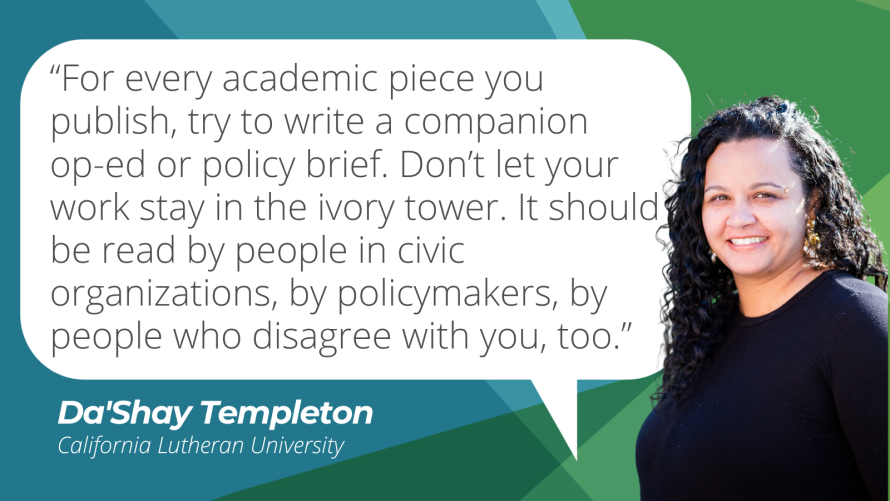
And for every academic piece you publish, try to write a companion op-ed or policy brief. Don’t let your work stay in the ivory tower. It should be read by people in civic organizations, by policymakers, by people who disagree with you, too.
Also, publish open access if you can. It’s expensive, but it makes your work accessible, and when you cite it in public writing, people can actually read it.
And lastly, dream big. SSN had us write down what policies we’d change if we had unlimited funding and support. That was such a helpful exercise. It helped me clarify what I really care about and how to align my work with action.
You mentioned a potential study—any other projects or collaborations you’re excited about?
Yes! I’m planning a study on child homelessness in Ventura County. California has some of the highest rates of child homelessness in the country, and Ventura is no exception. Housing is expensive, jobs are scarce, and I want to understand how that’s affecting children’s academic outcomes, physical health, and school discipline.
I’ve been talking to my mentor about possibly doing a conference on the project, even if the grant doesn’t come through. I’m building a proposal that includes forming a policy advisory board—educators, social workers, community advocates—all working together to figure out solutions and mitigation strategies. That kind of thinking—big picture, strategic, community-centered—comes directly from SSN’s influence.
I’m also working on a corporal punishment study, following up on the district I mentioned that ended the practice, and two projects focused on Indigenous populations.
And I’ve got two more op-eds in the works—one on physical fitness, one on corporal punishment. So we’ll see where they land!