
Member Spotlight: Larry Walker Is Bridging Research, Policy, and the Common Good

Larry J. Walker doesn’t just talk about public scholarship—he’s built his career around it. An associate professor of education at the University of Central Florida and a former Capitol Hill staffer, Walker has spent his career moving between research and policy, always with an eye toward what he calls “the common good.”
That commitment is what led Walker to participate in the Scholar Strategy Network’s 2025 Education Scholars Training Program (ESTP) cohort, where he worked directly with policymakers and thought more deliberately on how his scholarship can shape public debate and legislative action.
The fellowship “really gave me an opportunity to think about my positionality as a researcher and as a public policy person,” Walker said. “I’m being more reflective about what the common good is as it relates to society.”
One of Walker’s goals during the fellowship was to explore ways to offer rental assistance for teachers to address the teacher shortage in Florida. The program connected Walker with Florida State Representative Yvonne Hinson, who was developing legislation to address homelessness. During the meeting, Walker learned that Hinson was still working on her bill and “asked if I’d be willing to take a look and offer some feedback. I was happy to do that.”
Walker reviewed draft language and offered feedback on what would eventually become HB 51, a bill introduced in the Florida House in September 2025. HB 51 aims to create tax credits for businesses that provide housing for employees and to encourage the rehabilitation of unused housing stock.
For Walker, the bill aligned closely with his broader research interests. Around the same time it was introduced, he was co‑authoring a manuscript examining how Democratic and Republican members of Congress have addressed homelessness over the past 25 years.
“This idea is, what is in the best interest of society,” Walker said. “When we give people the opportunity, whether through temporary or long‑term housing, it has a positive impact on communities. I think it’s incumbent on us as citizens to do something about an issue that can be solved through public policy.”
With Florida’s recent legislation penalizing outdoor encampments, Walker felt a growing urgency to engage a wider public audience. He wrote an op‑ed for the Orlando Sentinel arguing for more humane and effective approaches to homelessness, particularly for veterans, families, and children.
Public communication has long been part of Walker’s work. In addition to writing, he regularly appears on local and national television as a political commentator, explaining complex policy issues in clear, accessible terms. His commentary has covered everything from a preview of President Trump’s State of the Union address to discussions on Florida’s property tax policy.
That comfort with media and public audiences grew out of his time on Capitol Hill, where he began his career as a Congressional Black Caucus Foundation fellow before quickly rising to legislative director for Representative Major R. Owens of New York. In that role, Walker oversaw a broad portfolio that included education, criminal justice, appropriations, environmental issues, and foreign affairs.
“As a legislative director, I had to be a generalist,” he said. “I understand relationships with the press, and I really enjoy explaining complex topics to make sure that the public understands them.”
Walker credits SSN and the ESTP fellowship with sharpening how he connects his research, policy background, and public engagement. He also values the opportunity to build relationships with other scholars across the country who are navigating similar questions about public engagement.
Looking ahead, Walker remains focused on work that serves the common good. He currently has two books under contract, including a co‑authored volume on improving access and outcomes for Black men in postsecondary education. “A lot of my work is around experiences of Black males,” he said. “That’s not just research—it’s a lived experience.”
Whether through scholarship, policy collaboration, or public commentary, Walker sees his role as fundamentally civic. “I just want to continue to do good work,” he said. “And wherever that takes me, that’s where I’ll go.”
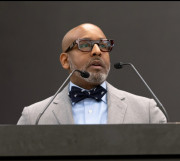
Dr. Walker's research focuses on racism, leadership, and policy. Previously, he served as the Legislative Director for former Congressman Major R. Owens and a Congressional Fellow with the Congressional Black Caucus Foundation. During his tenure on Capitol Hill, Dr. Walker supervised the Congressman's legislative staff, drafted legislation, and negotiated legislative language to reach bipartisan and bicameral consensus.