
Member Spotlight: Miranda Yaver Is Turning Research into Real-World Impact

For health policy scholar Miranda Yaver, research is not meant to sit quietly behind journal paywalls. She believes it should move into government offices, newsrooms, classrooms, and everyday conversations with people navigating the American health care system.
Now an assistant professor of health policy and management at the University of Pittsburgh, Yaver put it simply, “I really enjoy doing academic research, but this shouldn’t be purely an intellectual exercise.”
That idea—research as something meant to be used—has led Yaver to engage in many different ways through the Scholar Strategy Network. With support from the network, she has taken on leadership roles to organize scholars and advise policymakers. She’s written op‑eds, been quoted in news articles, and appeared on television and podcasts. Across these venues, she has focused on making complex health policy research understandable and relevant to ongoing debates.
Yaver earned her PhD at Columbia University with a focus on American politics and did not plan to specialize in health policy. But while dealing with health issues of her own, she found herself confronting the complexities of insurance coverage firsthand.
“Running into health issues all too often in America means running into insurance issues,” she said.
Despite her education and a job flexible enough to allow her to spend hours navigating the system, she still struggled. That realization stuck with her and prompted a broader question: “What does my neighbor do?” That question ultimately shaped her research agenda, leading her to postdoctoral research in health policy and, eventually, to her forthcoming book, Coverage Denied: How Health Insurers Drive Inequality in the United States.
Within SSN, Yaver co‑leads the SSN Central Pennsylvania chapter, where she has organized programming that connects scholars with local investigative journalists and highlights regional public health challenges. “These briefings really foster dynamic discussions about policy priorities,” she said, noting that they also help scholars think more clearly about how their research might inform public debate beyond academic audiences.
Yaver has also been deeply involved in SSN’s Medicaid working group, particularly during negotiations surrounding what became the One Big Beautiful Bill. During that period, she spoke with legislative staff and wrote op‑eds in The Hill, MedPage Today, and STAT News to warn about the consequences of sweeping Medicaid cuts.
Beyond highlighting the challenges of America’s healthcare system, Yaver is also intentional about offering a path forward, particularly when speaking with policymakers. “I really try to be in solution mode,” Yaver said, noting that feasibility and political context matter as much as identifying what is wrong.
That holds true for her work at the state level as well. Through meetings facilitated by SSN, Yaver recently spoke with members of the Maryland LGBTQ+ caucus about how states and hospital systems can navigate new federal constraints on gender‑affirming care. Those conversations, she said, focused on “the realm of state flexibility” and on what states could realistically do to protect patients from harmful policy changes.
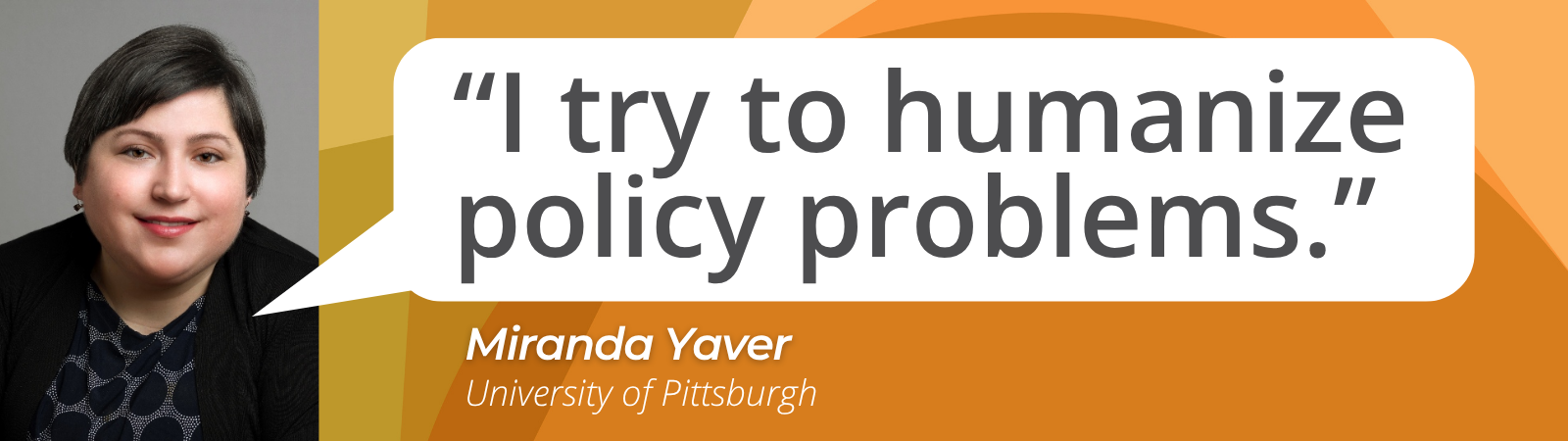
Yaver approaches these conversations much the way she approaches teaching: with her audience in mind. “I try to humanize policy problems,” she explained, pairing stories with just enough data to show broader patterns without overwhelming her audience. And she has a unique background that comes in handy for both situations: stand-up comedy. Yaver has performed at open mics and clubs in New York, Boston, and Los Angeles.
“Teaching is so performative that it seems very complementary to stand‑up comedy,” she said. “Audience matters a lot, and tone matters a lot.”
Balancing research, teaching, media engagement, and policy work, Yaver said, is not easy. She is candid about burnout and the need to set better boundaries. “I worked over 60 hours last week,” she said, adding that learning when to say no remains an ongoing challenge.
Still, she finds motivation in the way her projects reinforce one another, such as how a Substack essay can spark a grant proposal, how a post on Bluesky promoting an op‑ed can lead to a message from a reporter, or how a public debate can inspire a new research question.
“Working in one space can sometimes fuel work in another,” she said.
At her core, Yaver still identifies first as a political scientist. But she sees her role as bridging disciplines and audiences, particularly when health policy debates are increasingly shaped by political forces rather than evidence alone. “Health policy delivery is intensely political,” she said. “And it’s important that those conversations are informed by evidence.”

Yaver's research lies at the intersection of US health law, politics, and policy, with a forthcoming book on administrative burdens and inequities driven by health insurance barriers. Her research has appeared in the American Journal of Political Science, Journal of Law, Economics & Organization, Scientific Reports, JAMA Pediatrics, Lancet Regional Health-Americas, Journal of Health Law, Politics, and Policy, and World Medical & Health Policy. She is the 2025 Author-in-Residence at the Roosevelt Institute.