What is the focus of your research?
Demetri: I study higher education broadly, with a particular focus on governance and student political engagement. I examine how colleges and universities function in society from both a top-down and bottom-up approach.
From the top down, I focus on governance, particularly boards of trustees. They have significant power over institutions but receive far less attention than students, faculty, and staff. I’m interested in their role in shaping universities despite not being involved in day-to-day operations.
From the bottom up, I study how students influence institutions through activism and campus engagement. I'm also interested in STEM education—specifically, how we train socially responsible scientists and engineers. I look at how curricula and co-curricular spaces shape not just technical skills but also an awareness of how their work impacts society.
Overall, my research explores higher education’s role in a diverse democracy, examining what moves institutions toward their goals—and what holds them back.
You recently met with the offices of two Republican members of Congress about your research. What were your goals for these meetings?
Demetri: My background in governance helped me engage with a bill aimed at improving federal collaboration with nonprofits.
At first, I wasn’t sure how it connected to my work, but since most colleges and universities are nonprofits, I realized it had implications for higher ed governance. The bill sought to enhance how the federal government works with nonprofits—like those providing disaster relief—by improving data collection and collaboration.
The focus of the meetings was to provide some suggestions on the bill. One of the suggestions was to narrow its scope because I wasn’t sure if, based on the way it was written, it was actually meant to be as expansive as it was. It used the language of nonprofits and 501(c)(3) organizations, but it didn’t specify any thresholds—like above or below a certain size—so it really included the full ecosystem of nonprofits. We had some conversations about how narrowing the bill could actually help make it more effective in achieving its goals.
Another thing was that the bill didn’t really address governance for nonprofits. Since nonprofits are required by law to have a governing board, I made some recommendations about how that could be leveraged to add transparency and accountability in working with the federal government. We also discussed what language around that might look like.
Lastly, there were some recommendations around what the bill described as emerging areas of nonprofit and federal government collaboration. I was trying to offer different ways of thinking about those areas, like considering AI and the role of nonprofits in serving rural communities. If the goal of the bill is to encourage the federal government to work with nonprofits, then it’s important to consider where there might be mutual interest in doing so.
How do you think these conversations went? Did anything stand out?
Demetri: It was eye-opening. I had a great debrief with Andrew Pope, SSN’s Director of Policy, and one thing I didn’t initially realize was how the bill was assigned to three different committees. I naïvely thought that meant it was a priority, but Andrew explained that multiple committee assignments can be a death sentence for a bill—it has to pass through more markups, creating more obstacles.
He also pointed out that this particular bill was originally introduced by a representative who was part of the group that ousted Kevin McCarthy. Because of that, it’s possible the bill was sent to multiple committees as political payback. That was a "House of Cards" moment for me—I was just trying to support the policy, but it turns out legislative strategy is deeply intertwined with internal political dynamics.
That said, the staffer was receptive, and they do plan to reintroduce the bill in the new Congress. Given the current congressional makeup, it may actually have a better chance this time.
One thing that made sense strategically is that the representative represents a coastal South Carolina district vulnerable to hurricanes. If you look at the bill through a disaster recovery lens, it makes sense—how can the federal government effectively collaborate with local nonprofits in disaster response?
But that reinforced my original concern—if the goal is disaster relief, applying the bill to every single 501(c)(3) doesn’t make sense. The staffer acknowledged that the language could be more specific to better target organizations involved in disaster response. That felt like a productive outcome—they trusted my assessment that the bill’s broadness could dilute its impact, and they seemed open to refining it.
What’s next for your work on this issue?
Demetri: I learned that doing research-informed policy work in an election year can be tricky. My meetings were in October, then there was the pre-election recess, and after the election, everything was in flux while they reorganized.
The plan was to reconnect in the spring—once they were ready to start marking up bills and finalizing legislative priorities. That time has come, so we’re reaching back out now that the new Congress is seated, committee assignments are clear, and new legislation is being introduced.
Back when we initially planned this, we didn’t know who would win the election, so we had to consider different scenarios. Now that things have settled, we have a clearer sense of how to engage.
What advice would you give to other researchers looking to get involved in policy conversations like this?
Demetri: One big takeaway for me was becoming more comfortable with my expertise and how it translates to policy. Initially, I assumed my role in these conversations would be strictly about higher education. But policymakers saw me as someone with expertise in governance, and higher ed was just one application of that.
Academics are trained to be hyper-specific and nuanced—“I only know about this one thing.” But policymakers think more broadly. If you know about governance, they assume you have insights into nonprofits, federal agencies, and institutional interactions with government. That shift in perspective was surprising but valuable.
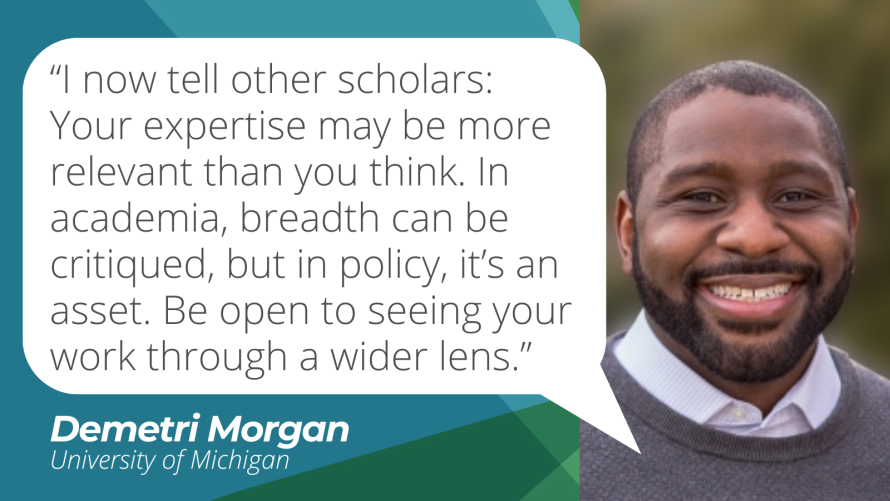
I now tell other scholars: Your expertise may be more relevant than you think. In academia, breadth can be critiqued, but in policy, it’s an asset. Be open to seeing your work through a wider lens.
Your policy meetings stemmed in part from your participation in the ESTP cohort. What has being part of the cohort meant to you?
Demetri: Three things stand out.
First, the chance to connect with other education scholars committed to bridging research and policy. At this stage in my career, structured professional development opportunities aren’t as common, so it was refreshing to be a student again—relearning things from high school civics to advanced policy engagement.
Second, the structured nature of the fellowship was invaluable. The monthly professional development calls, where we trained on op-eds and other skills, created a dedicated space for this work. Knowing that “the last Friday of the month is SSN time” helped make policy engagement a habit rather than an afterthought.
Third, I gained a deeper appreciation for how policymakers use evidence. In a workshop in Boston, we saw a slide illustrating all the different sources policymakers rely on—everything from local newspapers to conversations with neighbors. Research was just one of many factors.
That was humbling but also motivating. I now see that good research alone isn’t enough—it takes time, relationships, and persistence to influence policy. It’s not just about writing a strong policy memo; it’s about following up, becoming a trusted resource, and engaging beyond the research itself. That shift in mindset has reshaped how I approach this part of my career.
With the Trump administration making so many changes, how does that affect your work?
Demetri: It’s had an immediate impact. This moment has heightened the urgency of our work. I just came from two student meetings where there’s a lot of fear and frustration about what’s happening. My challenge is balancing realism and support—being honest about the threats while keeping people engaged and motivated.
It also means rethinking how we organize our work. The stakes feel higher, and the need for timely, effective responses has intensified. We’re constantly adapting to ensure our research and guidance meet the moment.
One of our major efforts in the coming months is emphasizing the importance of institutional independence. The Trump administration’s policies—whether the DEI executive orders, threats to dismantle the Department of Education, or potential endowment taxes—should raise alarms for trustees and higher ed leaders. While institutions must be accountable to taxpayers and government entities, there’s a difference between accountability and intrusion. Our concern is ensuring that political interference doesn’t prevent institutions from fulfilling their missions.
We’re working to help institutions and boards recognize when their autonomy is at risk. This includes producing talking points and resources that help higher ed leaders navigate these challenges while making their work more accessible to policymakers and the public.
We also recognize that different stakeholders have different concerns. Some may focus on DEI, others on cuts to NIH funding, and others on the potential loss of Pell Grants. Whatever the entry point, we want to build a broad coalition advocating for a reset—one where institutions remain accountable but are not subject to political overreach that undermines research, student support, and academic freedom.
Higher ed has work to do in rebuilding public trust, but that doesn’t mean allowing government overreach to dismantle what makes universities effective. Our project is about helping institutions draw clear lines, push back against harmful interference, and articulate their value to society in a way that resonates beyond the academic sphere.