
Evaluating Social Determinants of Health in Forensic Mental Health Settings Can Help Inform Recommendations for Youth
Connect with the author








Youth with Juvenile Legal Involvement
Youth with juvenile legal involvement (i.e., arrested or petitioned/charged) often come from socially complex environments shaped by a range of interrelated factors that contribute to their risk of engaging in illegal behaviors. Several of these factors—such as access to quality education and health care, exposure to violence, and the strength of one’s social network—are described within the social determinants of health framework which explores how the conditions in one’s environment affect health and well-being. Addressing social determinants of health alongside other risk factors can aid in more efficient resource and service allocation that can help reduce recidivism and improve outcomes for youth with juvenile legal involvement. However, social determinants are not routinely assessed or incorporated into service plans. Prior research has identified key reasons why social determinants of health are often not considered in current assessments, such as the length of time it may take to address them, and an increased focus on individual concerns.
Social Determinants of Health
Social determinants of health are typically grouped into five areas:





Assessing Social Determinants of Health
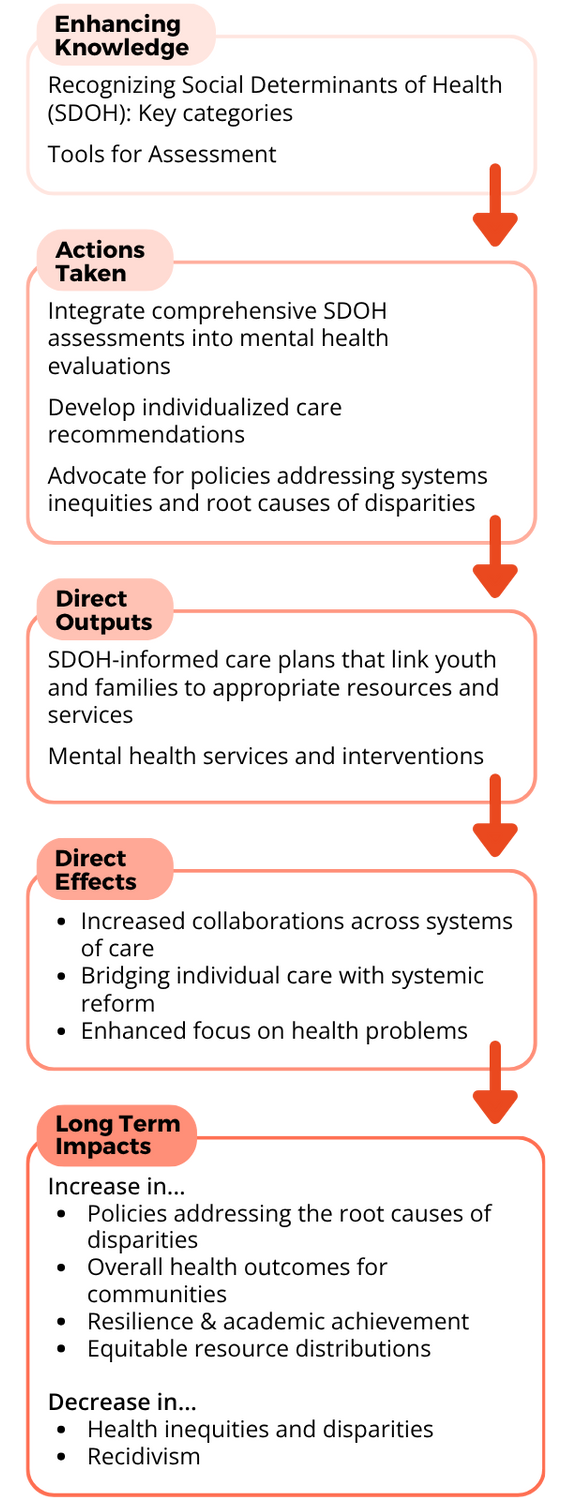 Because there are factors outside of one’s control that may impact health and well-being, it is important to recognize structural issues, like systemic racism, as contributing to social determinants. Thus, we propose asking questions about social determinants of health with intentionality and using them to inform recommendations for youth with juvenile legal involvement. While several screening tools exist that can be used to assess social determinants of health, most are designed for adults rather than youth. Further, individuals are often asked to complete a checklist (yes/no) rather than provide open-ended responses about how social determinants affect their health and well-being. Despite this, these tools can still serve as a framework for asking youth with juvenile legal involvement about their experiences. To promote open-ended responses and allow youth and their families to explain how social determinants have impacted their health and well-being (rather than assuming uniform experiences), we developed guided questions to assess social determinants of health across the five key areas to help inform recommendations so that they are individually tailored. The questions listed below encourage youth and families to share the types of support they may need.
-
Economic stability: Have you ever felt like you or your family did not have enough money to do things you needed to be well, like eat healthy food? In the last month, have you or your family slept outside, in a shelter, stayed with another family, or in a place not meant for sleeping? What was that like for you? In what ways do you feel supported or not supported by your family?
-
Education access: Have you ever felt like you did not have the support you needed to do well in school? Have you felt like you did not have opportunities to do well in school? What was that like? What supports or opportunities could you benefit from to do well academically?
-
Healthcare access: Have you ever not had access to regular healthcare appointments such as a pediatrician, dentist or eye doctor? Has there ever been a time when you could not obtain medical treatment, including medications when needed? How did that impact your overall health and wellness? What healthcare services do you need to promote your health and wellness?
-
Neighborhood and built environment: What makes you feel safe or unsafe in the neighborhood where you live? Are there places nearby where you can hang out, exercise, or spend time outside? What are those places like? Are there any problems where you live that affect your health or well-being?
-
Social and community context: How have you felt supported or unsupported by your friends? What types of social support do you think you need to promote your wellness?
Conclusion
It is recommended that these questions be more intentionally incorporated into forensic mental health assessments to provide youth and families with tailored recommendations. As illustrated in our flowchart, such tailored recommendations can help address systemic factors affecting youth, thereby reducing health inequities and supporting long-term resilience and well-being.